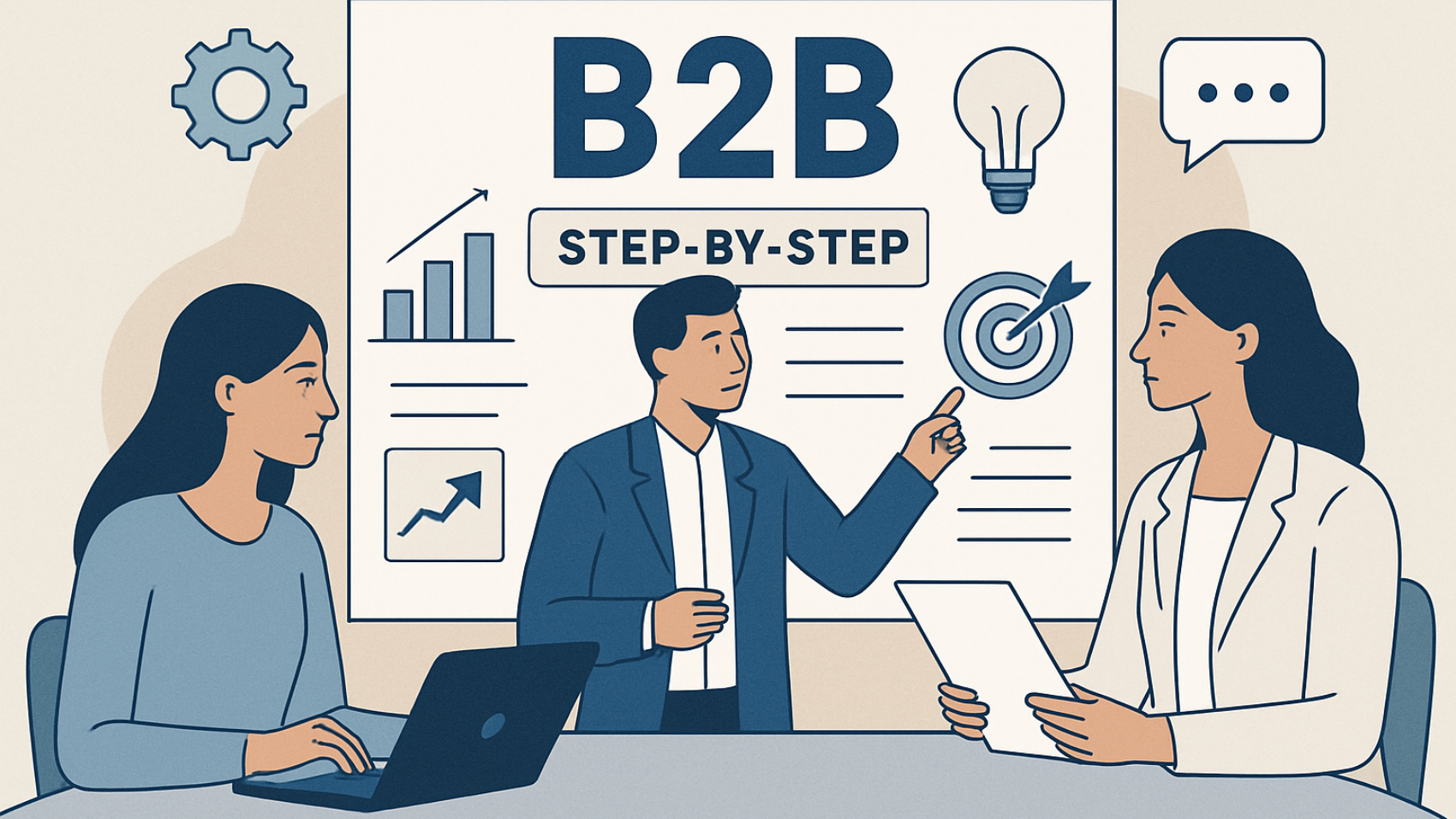
Why Most B2B Content Falls Flat — and What Actually Works
Most service-based businesses understand, at least in theory, that content marketing matters. They start a blog, post a few articles, maybe share them on LinkedIn once or twice, and then wait. When nothing comes of it, the conclusion is usually that content “doesn’t work for their industry.” The real problem is almost never the industry. It’s the absence of a coherent strategy behind the content.
B2B buyers — the decision-makers signing off on contracts for accounting firms, IT consultants, marketing agencies, legal practices, and every other professional service you can name — take longer to convert than retail consumers. They evaluate more. They read more. They talk to more people before committing. A B2B content marketing strategy isn’t about flooding the internet with blog posts. It’s about meeting those buyers at each stage of a careful, considered decision process and giving them something worth reading every time.
This guide walks through exactly how to build that strategy — from clarifying who you’re writing for, to choosing the right formats, to measuring whether any of it is actually working.
Step 1: Get Specific About Who You’re Trying to Reach
The single most common reason B2B content underperforms is that it was written for everyone, which means it resonates with no one. Before you write a word, you need a clear picture of the buyer you’re trying to influence — not a vague demographic sketch, but a real understanding of what keeps them up at night.
For a service business, that means asking questions like: What does this person’s working week actually look like? What decisions are they responsible for? What would make them look good in front of their own leadership team? What frustrations are they carrying around that a service like yours could quietly dissolve? The answers to those questions are not found in a spreadsheet. They come from sales call notes, from client conversations, from the questions people ask in discovery meetings, and from comments in the LinkedIn posts your prospects actually engage with.
Once you have that picture, you can build what’s often called an ideal client profile or buyer persona — but resist the urge to make it a generic template exercise. A useful persona is specific enough that you could read a piece of draft content against it and know immediately whether the tone, vocabulary, and concerns match. If your persona is “marketing manager, aged 30–45,” it won’t do that job. If your persona is “a head of marketing at a mid-size professional services firm who is under pressure to demonstrate revenue impact from their team’s activities and is sceptical of agencies that lead with creative over commercial outcomes,” it will.
Step 2: Map Content to the Buyer Journey
B2B buyers don’t move in a straight line, but they do move through recognisable phases. At the broadest level, there’s a phase where they become aware a problem exists, a phase where they actively research solutions, and a phase where they evaluate specific providers and make a decision. Your content needs to do different things at each stage.
Awareness-Stage Content
At this stage, your buyer knows something isn’t working, but they may not yet have the vocabulary to describe it precisely. Awareness-stage content earns attention by naming the problem clearly and framing it in a way that makes the reader feel understood. Think: explainer articles, thought leadership pieces that challenge a common assumption in the industry, or data-led posts that surface a trend your audience hasn’t fully processed yet. This content isn’t selling anything. It’s demonstrating that you understand the territory.
Consideration-Stage Content
Once a buyer is actively researching, they want depth. They’re comparing approaches, understanding trade-offs, and building an internal case for a particular direction. This is where detailed guides, comparison pieces, and process-oriented content shine. A professional services firm might publish a detailed breakdown of how to evaluate different approaches to a specific challenge their clients face — not to sell their own service directly, but to position themselves as the most knowledgeable voice in the conversation.
Decision-Stage Content
By the time someone is close to choosing a provider, they want proof. Case studies, portfolio examples, testimonials, and process walkthroughs all serve this stage. They answer the question: “Can this team actually deliver what they’re promising?” If you’re a service business without a strong body of social proof and real-world examples, building this content layer should be a priority before almost anything else.
Step 3: Choose Content Formats That Match Your Audience’s Habits
There’s no universally correct format for B2B content. The right choice depends on where your buyers spend their time, how they prefer to consume information, and what you can actually produce consistently at a high standard.
Long-form written content — detailed articles, guides, and opinion pieces — remains one of the most durable formats in B2B. It compounds over time through organic search, it can be repurposed into shorter social content, and it signals the kind of depth that builds genuine authority. That said, written content only works if it’s genuinely well-written. A 2,000-word post that meanders, repeats itself, and fails to reach a useful conclusion does more damage than no post at all.
LinkedIn has become the dominant organic channel for many B2B service businesses, particularly for solo consultants and boutique agencies where the founder’s personal voice carries real weight. A thought-provoking post from a credible individual often outperforms the same content published anonymously on a company page. If your buyers are active on LinkedIn — and in most B2B categories, they are — it deserves a dedicated content approach, not just a feed of recycled blog links. The ultimate guide to using LinkedIn for business expansion on this site goes into that in considerably more depth.
Video, webinars, and podcasts are worth considering if you have the production capacity to do them well. The bar for “well enough” is lower than most people assume — a clear, well-lit, well-edited talking-head video on a substantive topic will outperform a polished but empty one — but production quality still needs to meet a minimum threshold to avoid undermining your credibility.
Step 4: Build a Keyword and Topic Strategy Around Real Search Intent
Even the best-written content needs to be discoverable. For most service businesses, organic search is one of the highest-value acquisition channels available — it generates inbound interest from buyers who are already looking for a solution. Getting found requires understanding what your buyers are actually searching for, and writing content that genuinely answers those queries.
Keyword research for B2B service businesses tends to surface lower search volumes than consumer categories, but that’s not a reason to deprioritise it. A keyword attracting 200 searches per month in a high-value B2B niche can generate far more revenue per conversion than a consumer keyword with 50,000 monthly searches. The economics are completely different.
Focus first on high-intent, problem-aware queries — the kind of searches someone makes when they’re actively trying to solve something, not just browse. Layer in broader educational topics at the awareness stage, but make sure your core commercial pages are optimised first. It’s worth understanding what a proper technical and content audit looks like before you invest heavily in new content production — this breakdown of what an SEO audit should include covers the essentials clearly.
Beyond keywords, think in terms of topic clusters. Rather than publishing isolated articles on unrelated subjects, build a network of content around your core service areas. A central, comprehensive piece on a broad topic links to several more specific pieces that explore individual subtopics in detail. This structure is good for search engines and — more importantly — it’s good for readers who want to go deeper on something that caught their attention.
Step 5: Establish a Publishing Cadence You Can Actually Sustain
Consistency is one of the most underrated factors in content marketing success. The businesses that win through content are rarely those that publish the most — they’re the ones that publish reliably, at a quality level they can maintain over months and years.
The right cadence for your business depends on your resources, your team’s capacity, and the competitive density of your category. A solo consultant who publishes one deeply-researched article per month, every month, for two years, will almost certainly outperform a larger team that publishes three posts a week for three months and then burns out and goes quiet. Sporadic bursts of activity followed by long silences are worse than a modest but unbroken rhythm.
Build a content calendar that accounts for the full production process — ideation, research, drafting, editing, design if needed, publishing, and distribution. If you’re managing content alongside everything else a service business demands, that calendar needs to be realistic about capacity. It’s better to plan for one piece of content per month and deliver it than to plan for four and consistently fall short.
Step 6: Distribute Content Actively, Not Passively
Publishing content and distributing content are two entirely different activities. Most businesses treat them as the same thing: they hit publish, share the link once on social media, and call it done. That approach leaves most of the value on the table.
Active distribution means taking each piece of content and thinking deliberately about every channel, format, and audience where it might create value. A detailed article can become a LinkedIn carousel, a short-form video script, a thread of observations on social media, a section of a client newsletter, or a talking point in a sales conversation. The content doesn’t have to be created from scratch each time — it has to be adapted intelligently for each context.
Email newsletters deserve particular mention here. In B2B, a well-maintained email list of prospects, past clients, and referral partners is one of the most direct and reliable distribution channels available. People who have opted in to receive content from you have already signalled interest. Delivering genuinely useful content to that list regularly keeps you present in their consideration set without requiring them to seek you out.
Step 7: Measure the Right Things
Content marketing generates a wide range of metrics, most of which are noise. Page views, social impressions, and follower counts are vanity metrics unless they connect clearly to business outcomes. The metrics that matter for a service business are the ones that track progress toward real commercial results: qualified leads, sales conversations, proposal requests, and — ultimately — signed clients.
That said, it’s worth tracking a small number of leading indicators that predict downstream commercial impact. Organic search rankings on target keywords, email list growth rate, time spent on page for key content pieces, and repeat visit rates are all reasonable signals that content is doing useful work before it’s visible in the revenue line. The key is to choose a small set of metrics that you’ll actually review and act on, rather than building a sprawling dashboard that no one opens.
According to Salesforce’s B2B content marketing research, one of the most persistent gaps in B2B content programmes is the absence of a defined measurement framework before content is published. Most businesses don’t know what success looks like going in, which makes it impossible to evaluate whether it’s been achieved coming out.
A Question B2B Service Businesses Ask Constantly
How long does it take for B2B content marketing to generate leads?
The honest answer is six to twelve months before organic content typically begins to generate consistent inbound enquiries — and that timeline assumes content is published regularly, is genuinely well-optimised for search, and targets the right audience from the start. Paid amplification can accelerate early results, but organic content compounds over time in a way paid traffic does not: an article that ranks well continues to generate leads for years with no additional spend. Service businesses that treat content as a long-term asset rather than a short-term lead-generation tactic are the ones that see the most durable returns.
Putting the Strategy Into Practice
The gap between understanding content strategy and actually executing it consistently is where most service businesses stall. The concepts aren’t complicated. The discipline required to research properly, write clearly, publish consistently, distribute actively, and measure honestly — while also running a service business — is genuinely demanding.
One thing that helps is starting narrower than feels comfortable. Rather than trying to build a comprehensive content programme across every topic relevant to your business simultaneously, pick one or two core themes that map directly to your highest-value service areas and go deep on those first. Build authority in a tight area before expanding. The temptation to cover everything immediately is understandable, but it almost always produces thin content that ranks for nothing and persuades no one.
If you’re working through how to align your content with a broader digital presence — including how your website is actually performing for the visitors your content attracts — there are practical, no-cost improvements that make a measurable difference to conversion rates once you’re generating traffic worth converting.
The businesses that build lasting authority through content are rarely those with the largest budgets or the biggest teams. They’re the ones that commit to the process, stay consistent when results are slow to appear, and hold themselves to a standard of genuine usefulness rather than volume. That’s a higher bar than most competitors will clear — which is precisely why it’s worth clearing.