

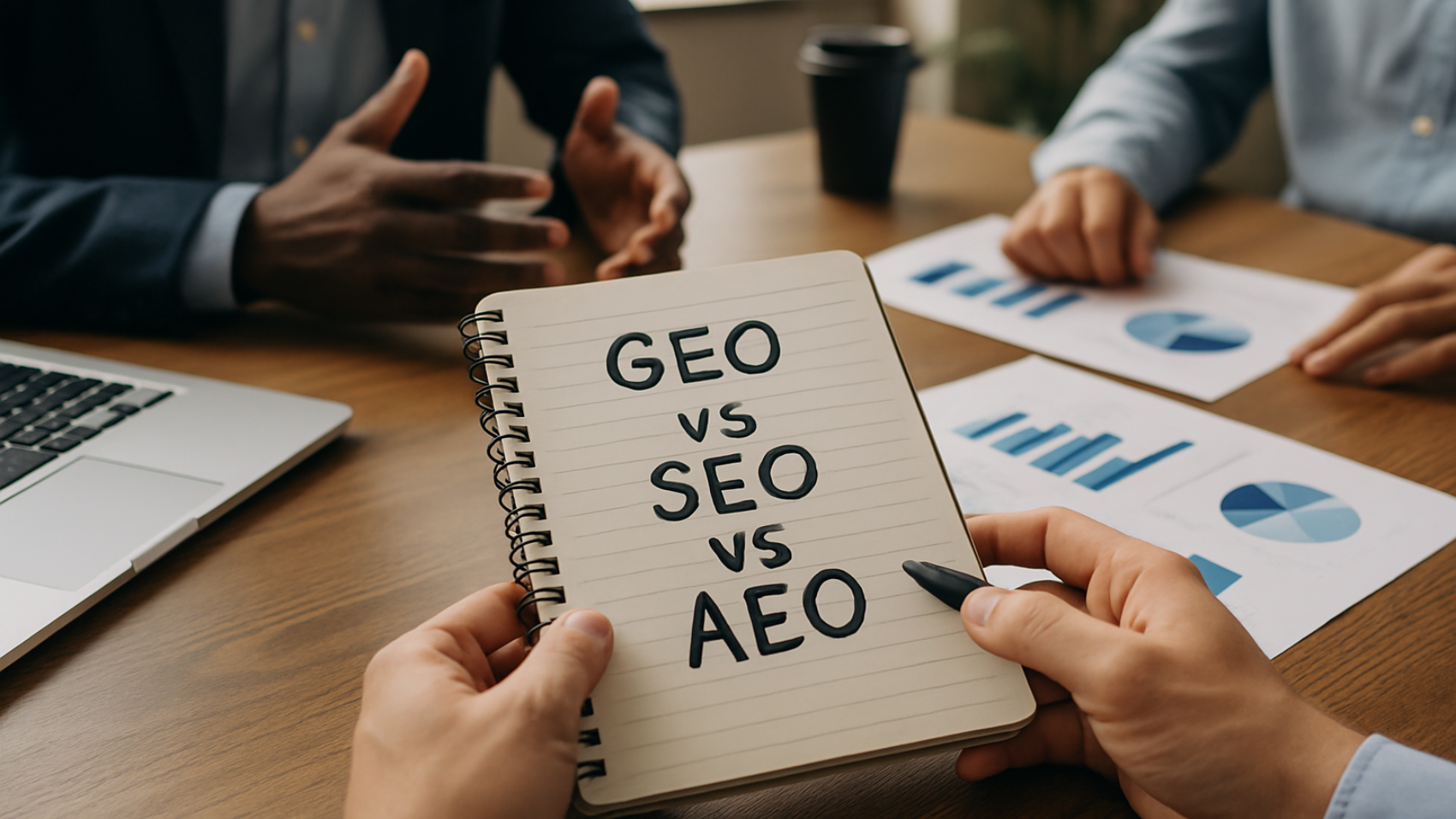
Search has changed more in the last two years than it did in the previous decade. The query bar is still there, but what happens after someone types into it looks nothing like it used to. If your digital marketing strategy still treats Google as a simple list of blue links to compete for, you are already playing catch-up. The conversation in 2026 centers on three overlapping disciplines: GEO vs SEO vs AEO. Understanding what separates them, and what connects them, is now a genuine business decision, not a technical footnote.
Three Terms, One Shifting Search Landscape
Before getting into priorities, it helps to be clear about what each term actually means in practice.
SEO (Search Engine Optimization) is the oldest of the three. It covers everything you do to earn visibility in traditional search engine results: technical site health, on-page content quality, backlinks, and structured data. It is still the bedrock of organic discoverability.
AEO (Answer Engine Optimization) emerged as voice search and featured snippets grew in prominence. The goal is to structure your content so that search engines and AI assistants can lift a precise, direct answer from your page and surface it immediately, often without a click.
GEO (Generative Engine Optimization) is the newest frontier. It focuses on making your content credible, citable, and structured enough to be referenced inside AI-generated responses, the kind produced by ChatGPT, Perplexity, or Google’s AI Overviews. GEO is less about ranking and more about being the source an AI trusts when it composes an answer on your topic.
What is the difference between GEO, SEO, and AEO?
SEO helps your content rank in traditional search results. AEO optimizes your content to be pulled as a direct answer by AI assistants and voice search tools. GEO goes a step further, structuring your content so it gets cited or surfaced inside AI-generated responses from tools like ChatGPT, Perplexity, and Google’s AI Overviews. They are related, but each requires a distinct approach.
Why This Distinction Matters More in 2026 Than It Did in 2024
The shift is not theoretical. AI-powered search features now intercept a meaningful portion of queries before a user ever scrolls to the organic results. For informational and research-heavy searches, which dominate B2B buying behavior, AI Overviews and generative answers are frequently the first and only thing a prospect reads.
That changes the competitive dynamic entirely. You can rank on page one and still be invisible if the AI summary above your result cites a competitor instead of you. As Insight Boutique notes in their 2026 search outlook, businesses that treat SEO, AEO, and GEO as separate silos will struggle to maintain visibility as generative answers become the default interface for many search sessions.
The implication for marketing strategy is real and immediate: you cannot ignore any of the three, but you also cannot invest equally in all of them at once. Knowing which to prioritize first is where most businesses get stuck.
Start With SEO, Because Everything Else Builds on It
There is a temptation to chase the newest thing. GEO sounds more exciting than fixing crawl errors or improving page speed. But AEO and GEO both depend on one foundational fact: AI systems and search engines can only surface content they can find, read, and trust. That means your SEO fundamentals need to be solid first.
If your site has serious technical problems, thin content, or no credible backlink profile, no amount of GEO-focused restructuring will make an AI engine choose to cite you. The technical groundwork matters more than ever. Our breakdown of how to identify and fix technical SEO issues covers the specific problems that block crawlers and AI systems alike from properly indexing your content.
Think of SEO as the plumbing. Nobody sees it. But without it, nothing else in the house works.
Which SEO Signals Matter Most for AEO and GEO Readiness?
Not all SEO work translates equally into AEO or GEO benefit. The areas with the highest crossover value right now are:
- Clear, well-structured content with explicit answers to specific questions
- Proper use of schema markup and structured data
- Strong internal linking that signals topical authority across your site
- High-quality, credible backlinks that build domain trust
- Fast load times and clean mobile rendering, since AI crawlers follow the same technical rules as Googlebot
If your internal link architecture is fragmented, AI systems will struggle to understand the depth of your expertise on any given topic. A structured internal linking audit, like the process outlined in our guide to auditing your B2B website’s internal linking strategy, is one of the highest-leverage moves you can make for both traditional SEO and generative engine visibility at the same time.
When AEO Should Move Up Your Priority List
Once your technical foundation is solid, AEO deserves real attention, particularly if your buyers use voice search, AI assistants, or tend to ask conversational, question-based queries.
AEO is fundamentally about clarity. It rewards content that answers a specific question in a direct, concise way, ideally in the first sentence or two after the question is raised. Featured snippets, People Also Ask boxes, and AI-generated answer cards all pull from the same type of well-organized, question-aware content.
For B2B service businesses especially, where buyers often search for answers to specific problems before they ever search for a vendor, AEO content can put your brand in front of a potential client weeks or months before they are ready to request a proposal.
Should a B2B business prioritize SEO, AEO, or GEO in 2026?
For most B2B businesses in 2026, the answer is not one or the other. SEO remains the foundation because it drives crawlable, indexable authority. AEO captures the growing share of voice and zero-click searches. GEO ensures your brand surfaces inside AI-generated answers, where a growing segment of your buyers now start their research. The right balance depends on your audience, your sales cycle, and your current content maturity.
GEO: The Discipline Most Businesses Are Ignoring Right Now
GEO is where the gap between early movers and everyone else is widest right now. Most businesses have not started thinking about it deliberately, which means the window for competitive advantage is still open, but it will not stay open indefinitely.
Generative Engine Optimization is not a set of tricks. It is a shift in how you think about the purpose of your content. The goal moves from “rank for this keyword” to “be the most credible, specific, well-structured source an AI would choose to cite when answering this question.”
Practically, that means writing with authority and depth rather than covering topics at a surface level. It means citing credible sources, using precise language, and organizing your content so that both a human reader and an AI parsing engine can immediately identify what question is being answered and what the answer is.
What GEO-Optimized Content Actually Looks Like
A GEO-ready piece of content typically has a few recognizable characteristics. It leads with the most important information rather than burying it. It uses descriptive subheadings that match the language someone would use when asking a question. It supports claims with specifics rather than vague generalities. And it demonstrates genuine expertise, the kind that comes from actually working in the field rather than summarizing what someone else already wrote.
This is precisely why the shift toward AI-driven digital marketing strategies is not just about tools and automation. It is about content that earns trust at the source level. Our piece on how AI-driven digital marketing strategies are helping B2B brands win in 2026 explores this dynamic in more depth, including how businesses are restructuring their content operations to account for generative search.
How to Decide What to Prioritize First
The right prioritization is not the same for every business. A few questions help clarify where to focus your energy.
How healthy is your technical SEO right now? If you have never run a proper audit, that is where the effort goes first. Visibility problems at the technical level will undermine everything else.
What is your buyers’ search behavior? If your prospects tend to ask specific, conversational questions early in their research process, AEO content can deliver pipeline value quickly. If they tend to ask AI tools for vendor recommendations or industry overviews, GEO readiness becomes the more pressing gap.
How mature is your existing content? If you have substantial content already published but it is not well-structured for direct answers or AI citation, a content audit and restructure may deliver faster returns than producing new content.
A disciplined 90-day planning approach, the kind covered in our guide to building a 90-day digital marketing plan for a B2B service business, is a practical way to sequence these priorities without trying to do everything simultaneously and spreading resources too thin.
The Integration Problem Most Businesses Miss
Here is the real issue underneath the GEO vs SEO vs AEO debate: most businesses treat these as separate projects assigned to separate people. SEO goes to the technical team. Content goes to the writers. AI strategy becomes a side conversation for leadership. The result is a fragmented presence that impresses none of the engines it needs to impress.
The businesses gaining ground in 2026 are the ones treating search visibility as a single, integrated system. Technical health, content authority, answer clarity, and generative credibility all feed the same outcome: being the source your buyers encounter first, regardless of where they start their search.
That kind of integration requires a clear strategy, honest assessment of your current gaps, and the discipline to close them methodically rather than chasing whichever trend generated the most noise last month.
If you are not sure where your business currently stands across these three dimensions, a structured digital marketing audit is usually the clearest place to start. The process of evaluating what you have, what is working, and what is actively holding your visibility back gives you a real baseline, which is the only reliable foundation for deciding what to prioritize next.
The search landscape in 2026 rewards businesses that understand the full picture. GEO, SEO, and AEO are not competing philosophies. They are sequential layers of the same goal: making sure that when your buyer is looking for what you do, they find you first, whether that is in a ranked result, a featured answer, or an AI-generated summary that names you as the authority worth listening to.
